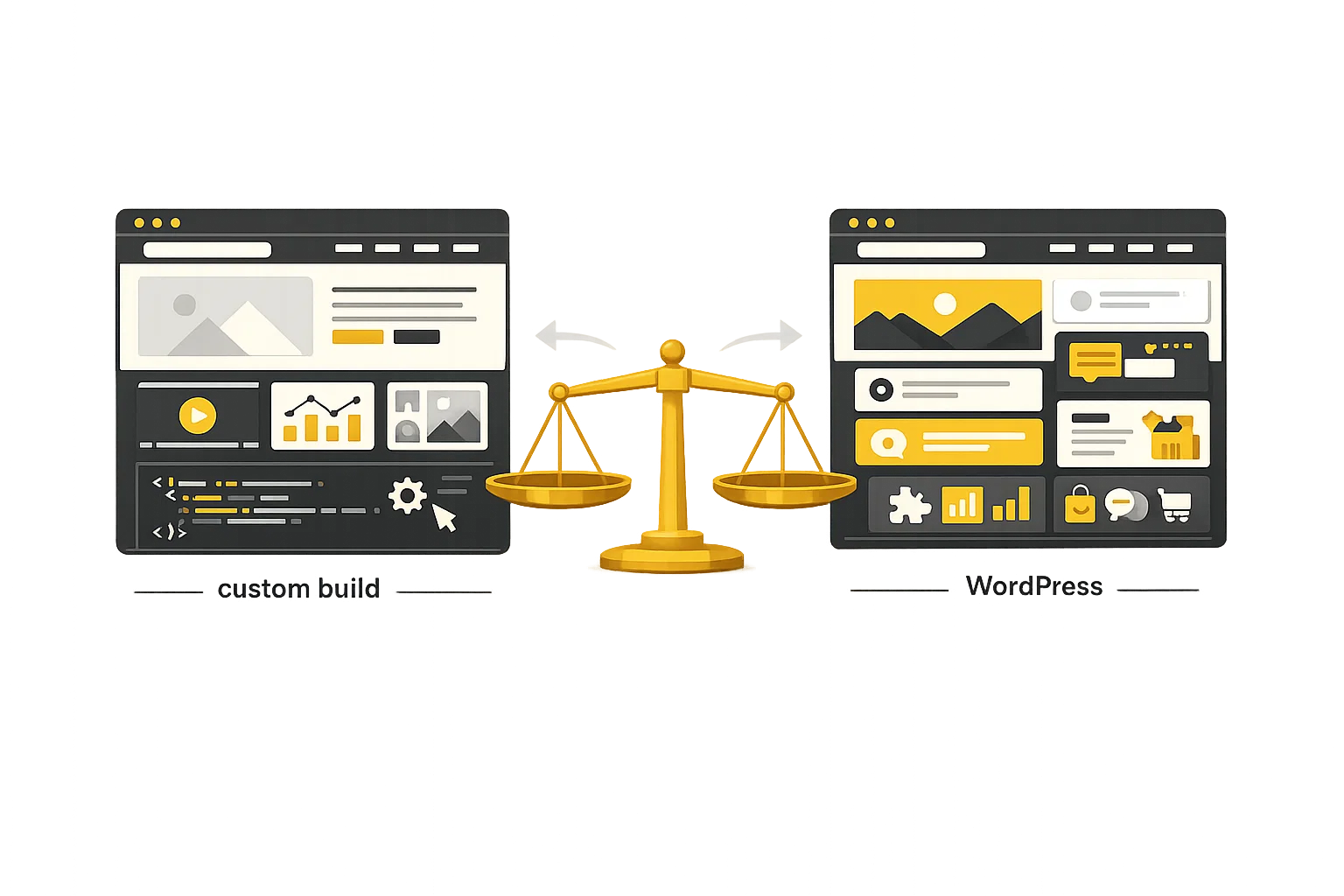

If you’re planning to build a business website in 2026, one of the biggest decisions you’ll face is this:
Should you go with a custom website or WordPress?
It’s a common question — and an important one.
Both options can create professional, high-performing websites. But they are built differently, priced differently, and suited for different types of businesses.
In this detailed guide, we’ll compare custom website vs WordPress from a practical business perspective — not from a technical debate — so you can choose what actually fits your goals.
What Is a WordPress Website?
WordPress is one of the most widely used website platforms in the world.
It allows developers to:
- Build websites using themes and plugins
- Customize layouts
- Add features like booking or ecommerce
- Manage content easily
A WordPress website is typically faster to build and more budget-friendly compared to fully custom development.
It’s popular among:
- Small businesses
- Local service providers
- Bloggers
- Ecommerce startups
- Agencies
What Is a Custom Website?
A custom website is built from scratch using coding languages like HTML, CSS, JavaScript, and backend frameworks.
It is not dependent on pre-built themes or standard plugin structures.
Custom websites allow:
- Unique design flexibility
- Tailored functionality
- Specific business logic
- Advanced integrations
They are ideal for businesses that need something beyond standard website features.
Let’s Compare: Custom Website vs WordPress
1️⃣ Cost Comparison
WordPress:
- More affordable
- Faster development
- Ideal for small to mid-level budgets
Typical small business website pricing is lower compared to custom builds.
Custom Website:
- Higher development cost
- Requires more time
- Better suited for businesses with complex needs
If budget is limited, WordPress is usually the practical choice.
2️⃣ Development Time
WordPress:
- Faster turnaround
- Pre-built tools reduce development time
- Ideal for businesses needing quick launch
Custom:
- Longer planning phase
- Full coding required
- More testing needed
If speed matters, WordPress usually wins.
3️⃣ Flexibility & Customization
WordPress:
- Highly flexible with plugins
- Suitable for most business features
- Some limitations if extremely unique functionality is needed
Custom:
- Unlimited flexibility
- Fully tailored logic
- Designed around your specific business model
If your business requires advanced systems or unique workflows, custom development may be better.
4️⃣ Ease of Management
WordPress:
- User-friendly dashboard
- Easy to update content
- No technical expertise required for basic edits
Custom:
- May require developer support
- Backend editing depends on structure
- Less beginner-friendly unless custom CMS is built
For most local businesses, WordPress offers easier daily management.
5️⃣ Performance & Speed
Both can be fast — if built correctly.
WordPress:
- Performance depends on theme & plugins
- Can be optimized effectively
Custom:
- Leaner structure
- No unnecessary code
- Highly optimized if properly developed
Custom builds often have performance advantages when complexity increases.
6️⃣ Security
WordPress:
- Secure if maintained properly
- Requires updates for themes & plugins
Custom:
- Security depends entirely on how it’s coded
- Fewer external dependencies
Security is not about platform — it’s about maintenance and proper configuration.
7️⃣ Scalability
WordPress:
- Scales well for most small to mid businesses
- Plugins support growth
Custom:
- Fully scalable for enterprise-level operations
- Built around expansion plans
If you plan aggressive technical scaling, custom may offer more long-term flexibility.
8️⃣ SEO Capabilities
Both platforms can rank well in search engines.
WordPress:
- Strong SEO plugins available
- Easy content optimization
Custom:
- SEO depends on coding structure
- Fully optimized if built correctly
SEO is more about strategy than platform choice.
When Should You Choose WordPress?
WordPress is ideal if:
- You are a small or local business
- You need a professional website
- You want booking or ecommerce features
- You have a moderate budget
- You want easy content management
Most local service businesses do extremely well with WordPress.
When Should You Choose Custom Development?
Custom websites are ideal if:
- You need unique business logic
- You require complex integrations
- You want a completely unique structure
- You are building a platform or SaaS model
- You need advanced automation
Custom development is often better for tech-heavy or system-driven businesses.
Real-World Example
Imagine two businesses:
Business A – Local Plumbing Service
Needs:
- Service pages
- Contact forms
- Booking system
- SEO optimization
WordPress is perfect.
Business B – Multi-location Property Platform
Needs:
- Advanced property filtering
- Custom dashboards
- User accounts
- Complex search logic
Custom development might be more suitable.
The Biggest Mistake to Avoid
Many business owners assume:
Custom = Always better
WordPress = Basic
That’s not true.
WordPress powers millions of professional websites — including large businesses.
Custom isn’t automatically superior. It’s just different.
The better option depends on your business model, budget, and long-term goals.
Final Verdict: Which Is Better?
There is no universal winner in the custom website vs WordPress debate.
Here’s the simple rule:
- If you’re a local business wanting professionalism, scalability, and affordability — WordPress is usually the smart choice.
- If you need unique systems, deep automation, or technical innovation — custom development may be better.
In 2026, success isn’t about the platform.
It’s about:
- Clear structure
- Professional design
- Strong user experience
- Conversion-focused layout
Choose the option that aligns with your business — not trends.